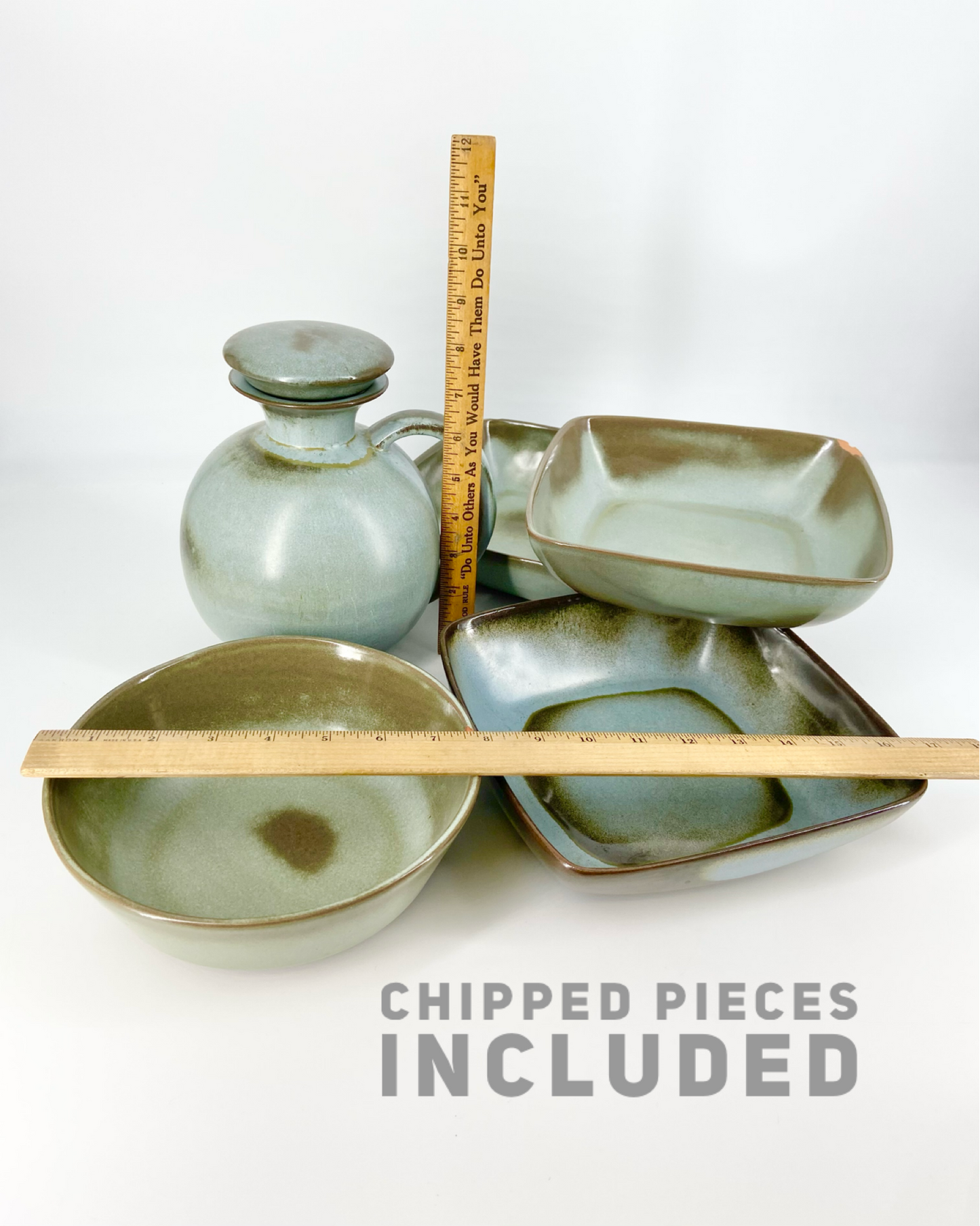


Set - Vintage Frankoma Pottery - Plainsman & Mayan Aztec in Woodland Moss - 119 pieces
Set - Vintage Frankoma Pottery - Plainsman & Mayan Aztec in Woodland Moss - 119 pieces
119-Piece Original Frankoma Pottery Collection: Plainsman & Mayan Aztec in Woodland Moss
There is a certain kind of pottery that seems to carry more than clay and glaze. It carries the feeling of a table being set, a cabinet being opened, a serving dish being placed at the center of a meal, a bowl being reached for without ceremony because it has become part of everyday life. Frankoma pottery belongs to that tradition. It was made to be useful, but it was never merely utilitarian. Its forms have weight, presence, and purpose. Its glazes feel connected to landscape, mineral, fire, and time.
This 119-piece collection of original Frankoma Plainsman (with a handful of Mayan Aztec pieces) pottery brings that spirit together in one substantial offering. Each piece is a stamped original, gathered into a collection that includes both the practical and the exceptional. There are strong quantities of everyday pieces, including plates and bowls, along with rare serving and decorative pieces that give the collection depth, scale, and collector appeal. It is the kind of grouping that shows Frankoma not as a single object or isolated find, but as a broader story of American pottery meant for use, display, gathering, and memory.
Frankoma Pottery was founded in Oklahoma in 1933 by John Frank, an artist, educator, and ceramicist whose work helped shape one of the most recognizable names in American pottery. Frank had studied ceramics and taught at the University of Oklahoma before establishing the pottery that would carry his name. From the beginning, Frankoma was closely tied to place. Its identity was built around Oklahoma clay, regional inspiration, strong forms, and glazes that reflected the warmth and earthiness of the American Southwest and Great Plains.
In 1938, Frankoma moved to Sapulpa, Oklahoma, a location that became central to the company’s long history. Sapulpa clay and Oklahoma materials helped give Frankoma pieces their distinctive character. The pottery was made with an understanding that useful objects could also be beautiful objects, and that beauty did not need to be fragile, distant, or formal. Frankoma dinnerware, serving pieces, vases, decorative forms, and specialty pieces were made to be handled and lived with. That combination of usefulness and artistry is one of the reasons Frankoma remains so admired by collectors.
This collection reflects that lasting appeal. It includes the kinds of pieces that belonged naturally in American homes: plates stacked for meals, bowls ready for daily use, serving pieces brought out for gatherings, and decorative forms that added character to a room. At the same time, the size and cohesion of the collection give it an importance beyond ordinary tableware. A large grouping allows the glazes, forms, and design language to be seen together, revealing the personality of Frankoma across multiple uses and shapes.
This collection is finished in Frankoma’s Woodland Moss glaze, a distinctive rutile glaze produced approximately from 1960 through 1974. Woodland Moss belongs to an especially interesting period in Frankoma’s history, when the company’s color palette expanded and evolved through the 1960s and early 1970s. While earlier Frankoma glazes established the company’s earthy foundation, this later period introduced additional glaze choices that brought new character to familiar forms. Woodland Moss is one of those memorable finishes.
Despite its name, Woodland Moss is not simply a green glaze. It is often described as a rich meeting of medium blue and brown, producing a surface that can appear mossy, earthy, blue-green, brown, softly shaded, and beautifully varied depending on the clay, the firing, and the shape of the piece. One piece may lean toward a deep, moody blue-green; another may reveal more brown warmth; another may show a softened blend of both. That range is part of the charm. Woodland Moss has a quiet complexity, the kind of surface that rewards a closer look.
Woodland Moss is a rutile glaze, and that is central to its character. Rutile glazes are prized for movement and variation rather than flat uniformity. The glaze responds to the form beneath it, settling differently around rims, handles, embossing, curves, and molded details. On a plate, the glaze may gather subtly near the edge. On a bowl, it may deepen where the form curves inward. On a handled serving piece, the color may shift around the handle and rim. On embossed pieces, the glaze may highlight raised decoration, creating contrast through shadow, pooling, and surface variation.
Those natural differences are not flaws; they are part of what gives Woodland Moss its appeal. Frankoma pottery was shaped by clay, glaze chemistry, kiln conditions, and form. Woodland Moss records those relationships visibly. In a collection of this size, the glaze can be appreciated across many shapes at once. Everyday plates and bowls show its quieter range, while serving and decorative pieces allow its depth and movement to become more dramatic. Together, the pieces create a collection that feels unified by glaze and history, while still allowing each individual piece to have its own surface personality.
The Woodland Moss pieces also carry the design sensibility of Frankoma’s mid-century and early 1970s production period. This was a time when many American homes embraced colors and textures that felt natural, organic, and grounded. Woodland Moss fits that moment beautifully. It has the earthy weight associated with Frankoma, but its blue-brown and mossy tonal shifts give it a distinctive mood. It can feel rustic, modern, Southwestern, and quietly elegant at the same time.
A handful of Mayan Aztec pieces are also included in the collection, and these are also finished in Woodland Moss. The Mayan Aztec pattern is one of Frankoma’s most recognizable embossed dinnerware designs. First introduced in 1942, Mayan Aztec features a distinctive raised band inspired by Aztec design motifs. The pattern brings a sculptural quality to Frankoma tableware, adding rhythm, texture, and decorative strength while still remaining connected to functional dinnerware forms.
The history of Mayan Aztec adds another meaningful layer to the collection. The pattern was introduced during the early 1940s, interrupted in the mid-1950s, and then reintroduced in 1957. After its reintroduction, it continued in later glaze offerings, including Woodland Moss. That history makes the Woodland Moss Mayan Aztec pieces especially interesting: they connect a pattern first born in Frankoma’s earlier decades with a glaze associated with the company’s 1960s and early 1970s color expansion.
The Woodland Moss glaze is particularly effective on Mayan Aztec forms because it enhances the embossed design. The raised Aztec-inspired band catches the glaze differently than the flatter surfaces around it. The glaze may settle into recessed areas, deepen around molded detail, and create tonal shifts across the pattern. The result is a strong marriage of form and finish: the pattern gives the glaze more architecture, while the glaze gives the pattern more shadow, depth, and atmosphere.
Placed alongside the simpler Woodland Moss plates, bowls, serving pieces, and decorative forms, the Mayan Aztec pieces add texture and historical contrast. They do not feel separate from the collection; they expand it. The shared Woodland Moss glaze creates continuity, while the embossed Mayan Aztec pattern brings visual interest and collector significance. Together, they show how Frankoma could adapt a form across decades and glazes while preserving its regional and artistic identity.
Condition has been carefully noted. The collection is presented as 119 pieces, with 110 pieces in very good condition and 8 pieces noted as having small chips. The chipped pieces are included with the set. These condition details are part of the honest story of vintage pottery: pieces made to be used, stored, moved, displayed, and appreciated over time. The strength of this collection lies in its size, originality, stamped authenticity, glaze cohesion, and the combination of everyday and harder-to-find forms.
This collection is being offered as one complete set only. Individual pieces are not available for separate sale. Keeping the group together preserves its visual impact and collector value, especially because the majority of the collection is unified by Woodland Moss and the Mayan Aztec pieces are also in Woodland Moss. A grouping of this size tells a richer story than scattered individual pieces can tell on their own.
The price for the complete 119-piece collection is $4,600. Shipping and handling will be charged separately, with appropriate care for a collection of this size, age, and material.
Shipping & Handling is set at $500 for the collection. You may also select store pick-up (for free) if you prefer. Store pick-up packing will include items wrapped in tissue and open topped boxes (not suitable for shipping).
Quick Reference:
- 119-piece original Frankoma Plainsman & Mayan Aztec pottery collection
- Each piece is a stamped original
- Sold as one complete collection only
- No individual piece sales
- Priced at $4,600 for the entire collection
- Shipping and handling charged separately
- Includes rare serving and decorative pieces
- Includes everyday tableware such as plates and bowls
- Majority of pieces are Woodland Moss
- Includes Mayan Aztec pieces also in Woodland Moss
- 110 pieces are in very good condition
- 8 pieces have small chips and are included with the set
- Frankoma Pottery was founded by John Frank in Oklahoma in 1933
- Frankoma moved to Sapulpa, Oklahoma, in 1938
- Frankoma is known for using Oklahoma clay
- Woodland Moss was produced approximately 1960 through 1974
- Woodland Moss belongs to Frankoma’s 1960s to early 1970s period of expanded glaze color offerings
- Woodland Moss is a rutile glaze
- Woodland Moss is often described as a rich meeting of medium blue and brown
- Woodland Moss can create mossy, earthy, blue-green, brown, and softly shaded effects
- Woodland Moss varies depending on clay, firing, and form
- Woodland Moss glaze may settle differently around rims, handles, embossing, curves, and molded details
- Natural variation is part of Woodland Moss’s appeal
- Mayan Aztec was first introduced in 1942
- Mayan Aztec is a distinctive embossed dinnerware pattern with an Aztec-inspired band
- Mayan Aztec production was interrupted in the mid-1950s
- Mayan Aztec was reintroduced in 1957
- Mayan Aztec continued in later glazes, including Woodland Moss
- Woodland Moss enhances the embossed Mayan Aztec pattern by adding depth, shadow, and tonal variation
All pieces stamped before glazing. Item numbers and units per item number are: 5QD x 1, 5GS x 1, 4K x 1, GS x 1, 201 x 1, 203 x 1, 6X x 2, 5D x 9, 5X x 4, 6E x 2, 5G x 5, 5FS x 3, 5F x 16, 30B x 1, 6F x 1, 6G x 1, F33 x 1, 218 x 1, 6N x 1, F34 x 1, 224 x 1, 5NS x 7, 31 x 1, 5C x 6, 7C x 6, 7G x 4, GC x 3, 302 x 1, 30A x 1, 43 x 1, 225 x 1, 5D x 2, 5S x 1, 37 x 3, 50A (creamer) x 1, 65 x 1, 4D x 1, 202 x 1, 4SC x 1, 5DB x 1, 6j x 1, 803bug x 1, 82 x 1, 6A x 1, 5+L x 1, 5M (mug) x 1, 1T (toothpick holder) x 1, sugar bowl (no number stamped) x 1, 1 item with no number stamped.
Couldn't load pickup availability
Share